

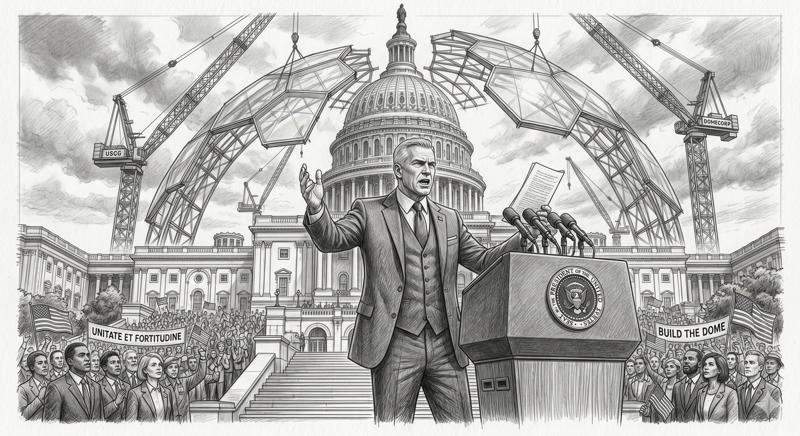
The Great Restoration: Julian Vane and the Architecture of American Exit
CALGARY — For nearly a century, the United States was the primary architect of global integration. From the post-WWII institutions of the UN and the World Bank to the digital hegemony of the early 21st-century internet, Washington was the center of a connected world. But the election of Julian Vane on November 5, 2024, signaled the definitive demolition of that era. Vane did not just win a presidency; he launched a "Great Restoration"—a radical ideological pivot that treats global integration not as a triumph, but as a systemic disease. To understand the world of 2026, one must first understand the Vane Doctrine: a philosophy of "Sovereign Purity" enforced by tariffs, concrete, and a relentless return to the analogue hearth.
The Rise of the Vane Dynasty
Julian Vane did not emerge from the traditional political machine. A billionaire tech-entrepreneur who made his fortune in "Hard-Grid" infrastructure (sub-surface power lines and localized desalination), Vane spent the 2010s observing the growing vulnerability of the American economy. He saw the "Great Integration" as a mechanism that allowed the APU to outsource its environmental costs to the Global South while hollowing out the American industrial heartland.
His rise was fueled by a carefully cultivated "Dynastic Image." While Julian handled the hard-power realpolitik, his sister, Clara Vane, became the world's most prominent proponent of "Fortress Architecture," and his nephew, Sam Vane, became the literal face of American excellence on the global sporting stage. Together, the Vanes presented a unified vision of strength, health, and national pride that resonated with a "quiet majority" weary of digital volatility and globalist mandates.
The Pillars of the Restoration
The Vane Doctrine rests on three primary pillars: The Heritage Tariff, The Neural Exit, and The Sovereign Dome.
1. The Heritage Tariff: Within his first hundred days, Vane implemented a universal 25% tariff on all imported finished goods, specifically targeting the medical and high-tech sectors of the APU. The goal was simple: force the re-shoring of American manufacturing by making imports prohibitively expensive. "If it's vital for our survival, it must be made on our soil," Vane declared. This move effectively terminated the frictionless trade model of the last fifty years, triggering a global microchip and medical machinery shortage that continues to define the 2026 economy.
2. The Neural Exit: Vane’s most controversial policy is his absolute rejection of the Aether-Link. While the APU views the neural implant as the pinnacle of human evolution, Vane views it as the ultimate security breach. He has classified the Aether-Link as "foreign espionage hardware" and mandated the "Neural-Exit" for all federal employees. This policy created a profound "Cognitive Border" between the US and the rest of the world. American government operates in an "Analogue Mode"—relying on physical records, vocal deliberation, and shielded, local networks—insulating it from the cyber-attacks and data-breaches that have paralyzed Europe and Asia.
3. The Sovereign Dome: The most visible symbol of the Restoration is the enclosure of central Washington D.C. under a climate-controlled, bio-secure polymer dome. Designed by Clara Vane, the Dome is the literalization of Vane's isolationist philosophy. It protects the seat of American government from extreme weather, biological variants, and digital intrusion. To the rest of the world, it is a symbol of American retreat; to Vane’s supporters, it is the "Shield of the Republic"—a guarantee that American democracy will endure even if the rest of the planet slips into chaos.
The Economic Heartlands vs. The Coastal Silos
The "Great Restoration" has radically altered the internal geography of the United States. The traditional tech hubs of San Francisco and Seattle, heavily integrated into the global AetherNet economy, have entered a period of sharp decline, hampered by tariffs and the federal crackdown on neural tech. Conversely, the industrial "Heartlands" of the Midwest and the South have experienced a sudden, state-subsidized resurgence.
Vane has nationalized the US energy grid, severing its links to the APU's "Green Mandate" pool and prioritizing cheap, abundant domestic production. This "Resource Nationalism" has made the US a low-cost energy sanctuary, attracting heavy industry back from overseas. However, the cost is a "Technology Gap." By decoupling from the global R&D network, the US is betting that its own "Artisan Innovation" can outpace the collective intelligence of the Connected Century. It is a high-stakes gamble on the endurance of the national spirit over the efficiency of the algorithm.
Geopolitics of the Vacuum
The "American Exit" has created a massive geopolitical vacuum that neither the APU nor the CSU has been able to fully fill. By withdrawing non-treaty troops and refusing to participate in international health or climate mandates, the US has essentially resigned its role as the "World Policeman." This retrenchment was a primary cause of the Arctic Resource War; without the deterrent of American naval power, the APU and CSU were forced into direct, kinetic competition over the North.
Vane’s strategy is "Strategic Distance." He provides high-resolution telemetry and "Heritage Defense" funding to those who defend their own borders, but he refuses to commit American lives to foreign land wars. This "Mercenary Support" model allows the US to maintain influence without the overhead of empire. It is a cold, clinical realpolitik that views the rest of the world as a series of buffer-zones rather than partners.
The Sovereign Horizon
As we move toward the 2026 mid-terms, the success of the Great Restoration is a matter of fierce debate. Inflation remains high, and the "Isolation Premium" is a daily reality for the American consumer. Yet, the sense of national purpose and the stability of the "Analogue Grid" have provided a psychological security that many other nations currently lack.
Julian Vane has proven that a primary power can, in fact, opt out of the 21st century. He has shown that the "Great Integration" is a choice, not an inevitability. Whether the United States can survive as an island of tradition in a sea of synthetic change remains to be seen. But the Sovereign Dome stands as a permanent reminder: the hearth is now more important than the network, and the era of American globalism is over. The Restoration is here, and it is built in concrete and steel.

