

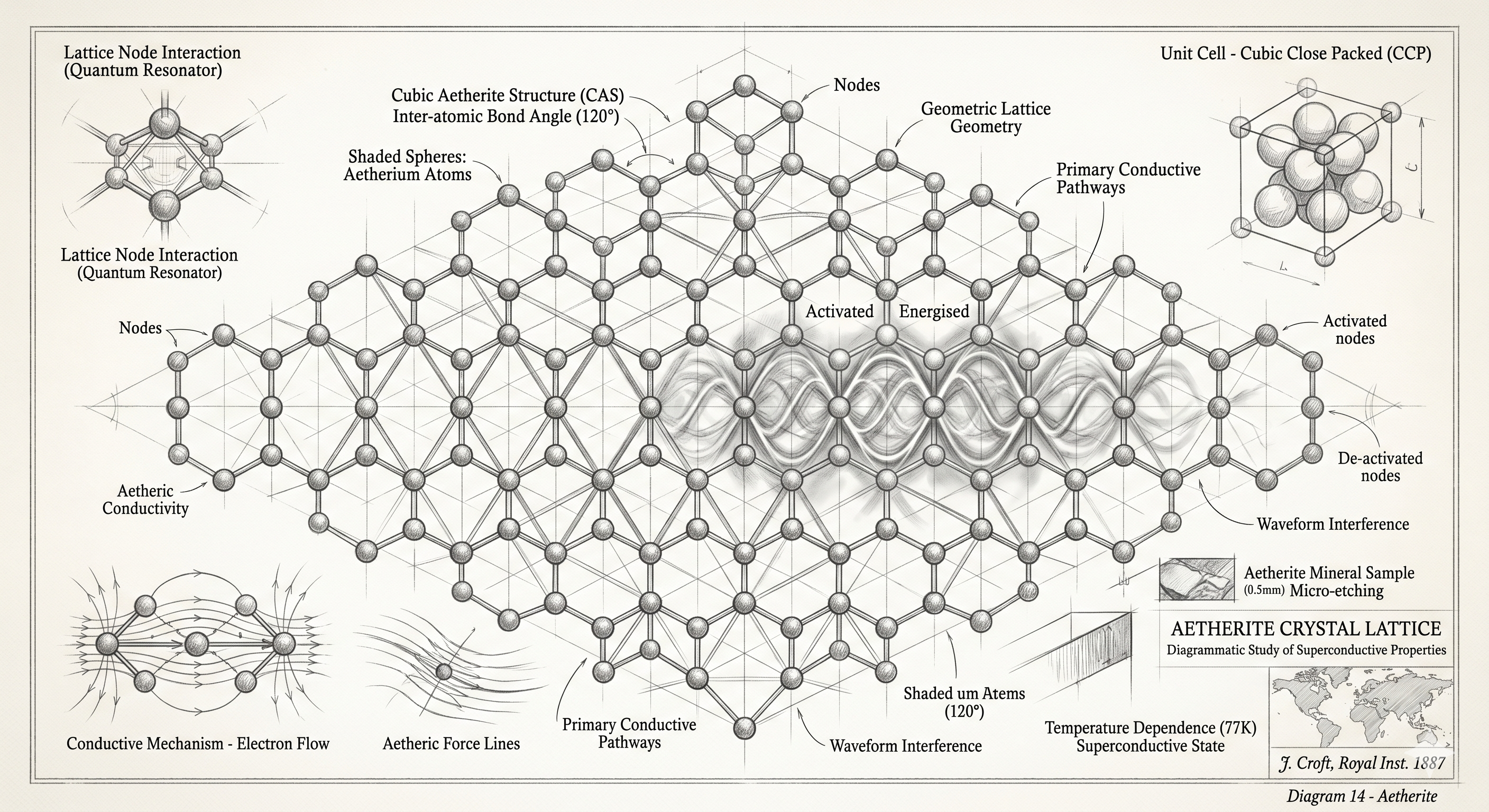
Aetherite: Technical Analysis of Room-Temperature Superconductivity in Andean Crystalline Nodes
Executive Summary
This report details the anomalous physical properties of 'Aetherite'—a novel crystalline silicate discovered in the high-altitude volcanic vents of the Andes. Preliminary findings confirm stable, room-temperature superconductivity (RTSC) at standard atmospheric pressure. The implications for global energy distribution and the AetherNet infrastructure are profound, necessitating an immediate reassessment of isotopic purity standards and resonant frequency applications.
Isotopic Purity and Lattice Structure
Aetherite (Substrate-Beta-1) exhibits a unique quasi-crystalline lattice that defies standard mineralogical classification. Spectroscopic analysis reveals an unprecedented isotopic purity of Silicon-28 within the crystalline nodes, exceeding 99.9999%. This purity level appears to be the primary catalyst for the suppression of phonon scattering, allowing for coherent electron pairing at temperatures up to 315 Kelvin (41.8°C).
The lattice demonstrates 'self-correcting' geometry under electromagnetic stress, a phenomenon we have termed Structural Elasticity. This suggests that the material is not merely a passive conductor but an active medium capable of modulating its own internal resistance in response to external stimuli.
Thermal Thresholds and Phase Transition
Unlike traditional superconductors requiring cryogenic cooling, Aetherite maintains its superconducting phase across a broad thermal band. Critical temperature (Tc) fluctuates marginally based on the local geomagnetic flux, yet consistently remains above the 290 Kelvin threshold. Above 320 Kelvin, the material enters a 'Metastable Plasma State', where conductivity is maintained but lattice integrity begins to degrade.
The 'Resonant Handshake' Experiments
The most significant discovery during the Q1 testing phase was the 'Resonant Handshake'. When two Aetherite nodes are tuned to the same quantum-phase frequency, they exhibit non-local entanglement. Power and data transferred between these nodes show zero attenuation and, more critically, zero latency.
The initial handshake was achieved at a distance of 14 kilometres between AHARF and the Laguna Colorada relay station. The signal-to-noise ratio remained absolute, even through heavy atmospheric interference. This 'Aetheric coupling' provides the theoretical foundation for the global AetherNet, suggesting a future where data is not transmitted, but merely 'synchronised' across the planetary node-mesh.
Conclusion and Security Recommendation
Aetherite represents the single most important strategic asset of the 21st century. Its ability to facilitate frictionless energy and information transfer will render current copper and fibre-optic infrastructures obsolete. It is recommended that the APU secure all known extraction sites in the Atacama and Andean corridors to prevent CSU-aligned interests from establishing a monopoly on RTSC-grade nodes.