

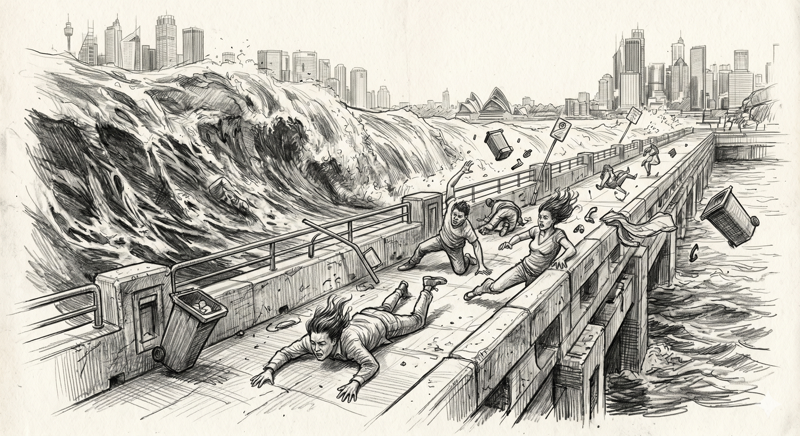
The ocean has long been our most patient adversary, but yesterday in Sydney, it felt like something more than a simple tide. The massive Seawall, designed to withstand the most violent storms of the 21st century, buckled under the weight of a calm, grey sea. As the water rushed into the Circular Quay, it carried with it a chilling realization: our world is more fragile than we ever dared to imagine, and the shields we have built to protect our hubris are failing.
While technocrats scramble to explain the "Gravity Anomaly" that preceded the breach, those of us on the ground felt it—a momentary, nauseating lightness, as if the earth itself had forgotten its weight. It was in that split second of cosmic hesitation that the wall gave way. Whether this is nature’s final protest against our industrial scarring or a byproduct of the "Static" that now haunts our atmosphere, the message is clear: we cannot control the forces we have unleashed.
"The wall didn't just break; it shattered like glass," said Marco Silva, a local rescue volunteer. "There were no waves. The water just... rose. Like it was being pulled from above. We talk about the CSU or the APU, but standing here, watching the harbour swallow the city, those names feel so small."
The Atlantic-Pacific Union (APU) has promised immediate aid, but the breach in Sydney is a breach in our collective confidence. We have spent billions on "climate-resilient" infrastructure while ignoring the deeper, spectral shifts in our reality. Nature—or perhaps something even more vast—is breaking through our barriers. It is time for humility, before the sea takes what is left of our pride.

