

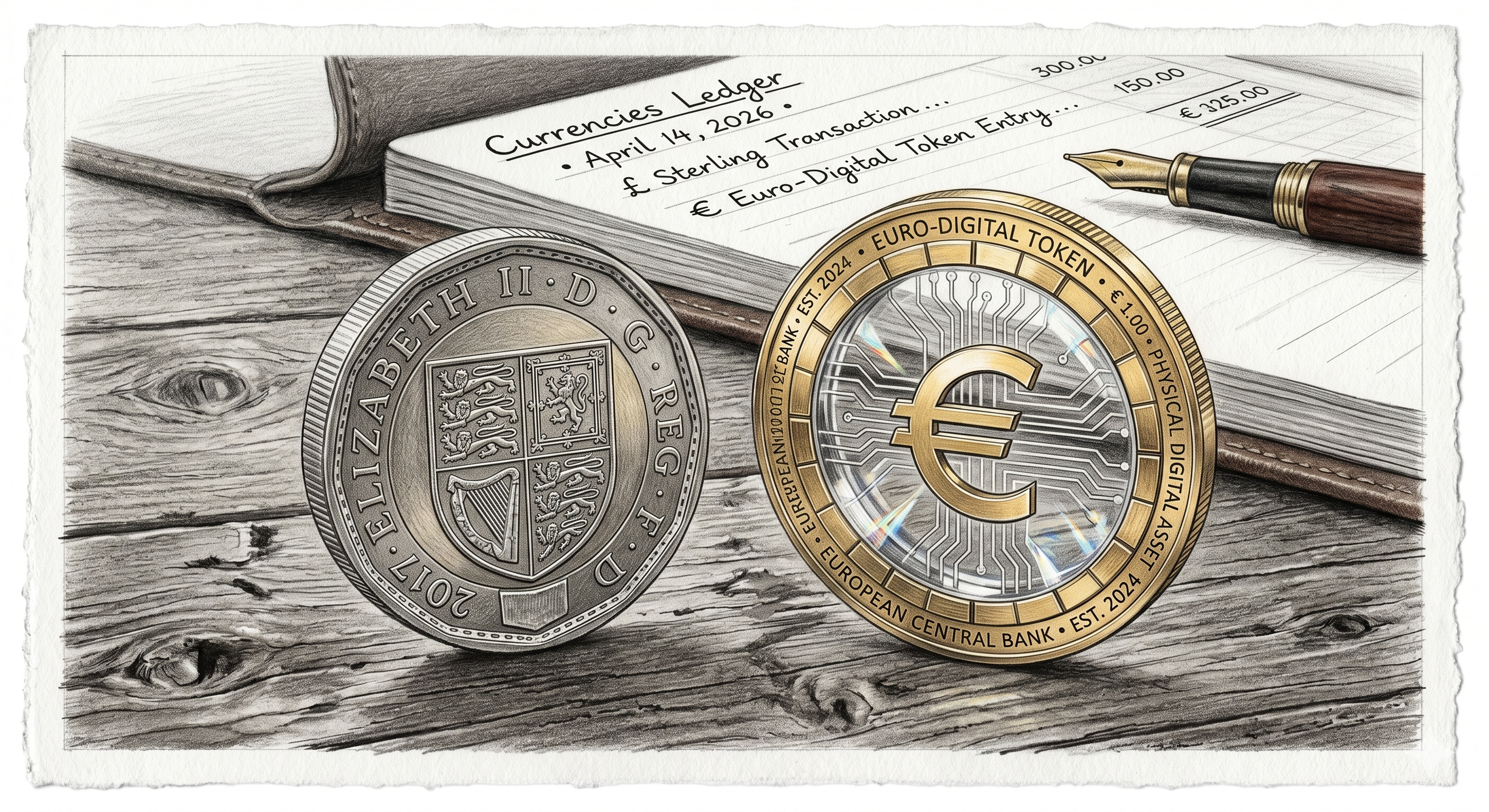
LONDON — In a move that signals the definitive end of post-Brexit isolationism, the United Kingdom officially implemented its "Dual-Currency System" today, allowing the Euro-Digital to circulate alongside the Pound Sterling in a historical bimetallic economic framework.
For the thousands gathered in Trafalgar Square, the flickering digital displays on the surrounding screens—showing real-time exchange rates between the "Old Pound" and the "New Euro"—felt less like a fiscal technicality and more like a liberation. As the clock struck noon, the first official transactions using the integrated Aether-Link wallets were processed, marking what Chancellor of the Exchequer Sarah Jenkins called "a bridge across the channel that no political tide can wash away."
The policy, a cornerstone of the Atlantic-Pacific Union’s (APU) "Great Integration" initiative, is designed to stabilise a British economy that has spent years adrift. By tethering the Sterling to the Euro-Digital, the government aims to reduce transaction costs for the precarious "Aether-gig" generation and provide a safety net for small businesses that have struggled with currency volatility.
"This isn't about losing the Queen's face on a coin; it's about keeping food on the table in a world that doesn't care about borders," says Marcus Thorne, a 24-year-old freelance coder from Manchester. Thorne, like many of his peers, has already switched his primary earnings to Euro-Digital. "The Pound felt like an anchor. The Euro-Digital feels like an engine."
Critics from the isolationist right have called this a "surrender of the Mint," but for those living in the crumbling council estates of the North, the pragmatic reality of a stable, integrated currency outweighs the romanticism of national sovereignty. The integration allows for seamless cross-border social credits and climate-mitigation grants, directly funded by the APU’s central treasury.
However, the transition is not without its "Quantum Jitters." Reports from several digital exchanges in London indicated minor synchronisation errors during the first hour of trade. While the government dismissed these as "routine firmware calibration," some tech-activists are whispering about "anomalous signal interference"—a term increasingly used to describe unexplained anomalies in the Aether-Link mesh.
Elena Rossi, reporting from the heart of the transition, sees this as a vital step toward a global commons. The Dual-Currency System is more than a monetary tool; it is a confession that the era of the solitary nation-state is over. As Britain plugs its economy back into the European heartbeat, the hope is that the scars of the last decade can finally begin to heal.

