

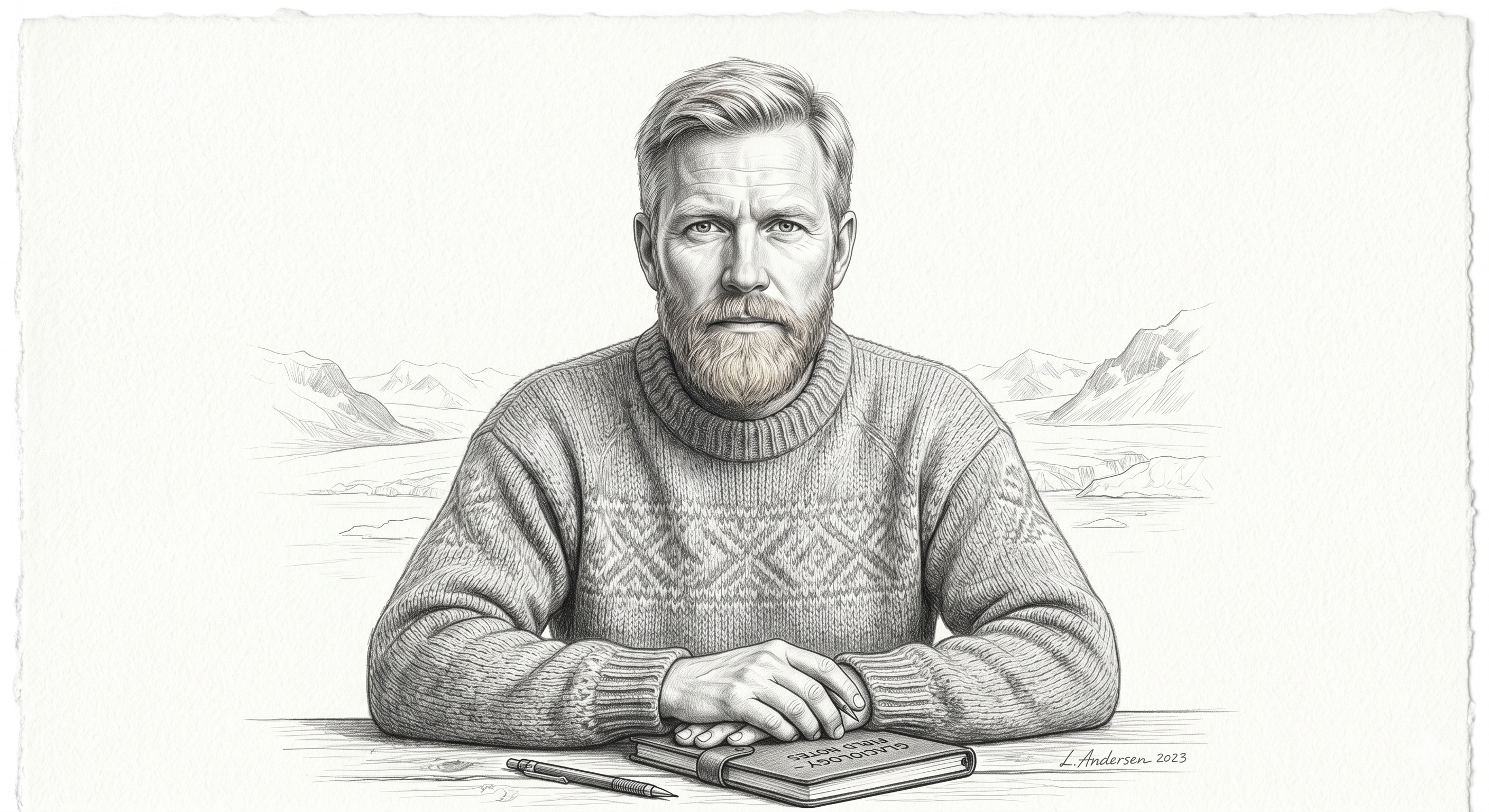
The Ice and the Needle: Glaciology and the Rhythms of Survival
OSLO — Sunday morning in Oslo is a time for the slow and the steady. I spend the early hours on my sailboat, navigating the fjord, observing the subtle shifts in the water temperature and the clarity of the air. When the cold finally drives me back to my study, I pick up my latest project: a traditional Nordic sweater. My passions for sailing, glaciology, and knitting are not as disparate as they might seem; all three are about understanding the slow, rhythmic patterns that underpin our volatile world.
Glaciology teaches us that the Earth has a memory that far exceeds our digital archives. The ice of the Arctic is a physical ledger of thousands of years of climate history. When we see a glacier retreat, we are not just witnessing a "resource event" or a "shipping lane opening"; we are witnessing the deletion of a fundamental piece of our planet’s story. In our "Connected Century," we are so focused on the "Now"—on the zero-latency ping and the real-time update—that we have lost the ability to think on a geological scale. We are failing the long-term audit of the Earth.
Knitting is my way of reclaiming that sense of time. To create a garment from a single thread requires a relentless, repetitive focus. Each stitch is a node in a physical network. If you rush, if you fail to maintain the tension, the entire structure eventually suffers. "The 'Great Integration' is currently suffering from 'Tension Failure'," I often tell my colleagues. We are trying to knit a global society too fast, without ensuring that the individual stitches—our national communities and our local ecosystems—are secure. The result is a network that is already starting to unravel at the edges.
As I work on the intricate patterns of the yoke today, I feel a profound sense of peace. The sailing teaches me the wind, the glaciology teaches me the ice, and the knitting teaches me the patience to bring them all together. We need more "Slow-Thinking" in our geopolitics. We need to stop treating the Arctic as a fast-paced "Resource War" and start treating it as the delicate, ancient system that it is. The ice doesn't negotiate, and the needle doesn't lie. As the world outside continues its frantic, high-bandwidth rush toward 2026, I will stay here, in the quiet of the morning, focusing on the next stitch. It is the only way I know how to truly prepare for the storm.

