

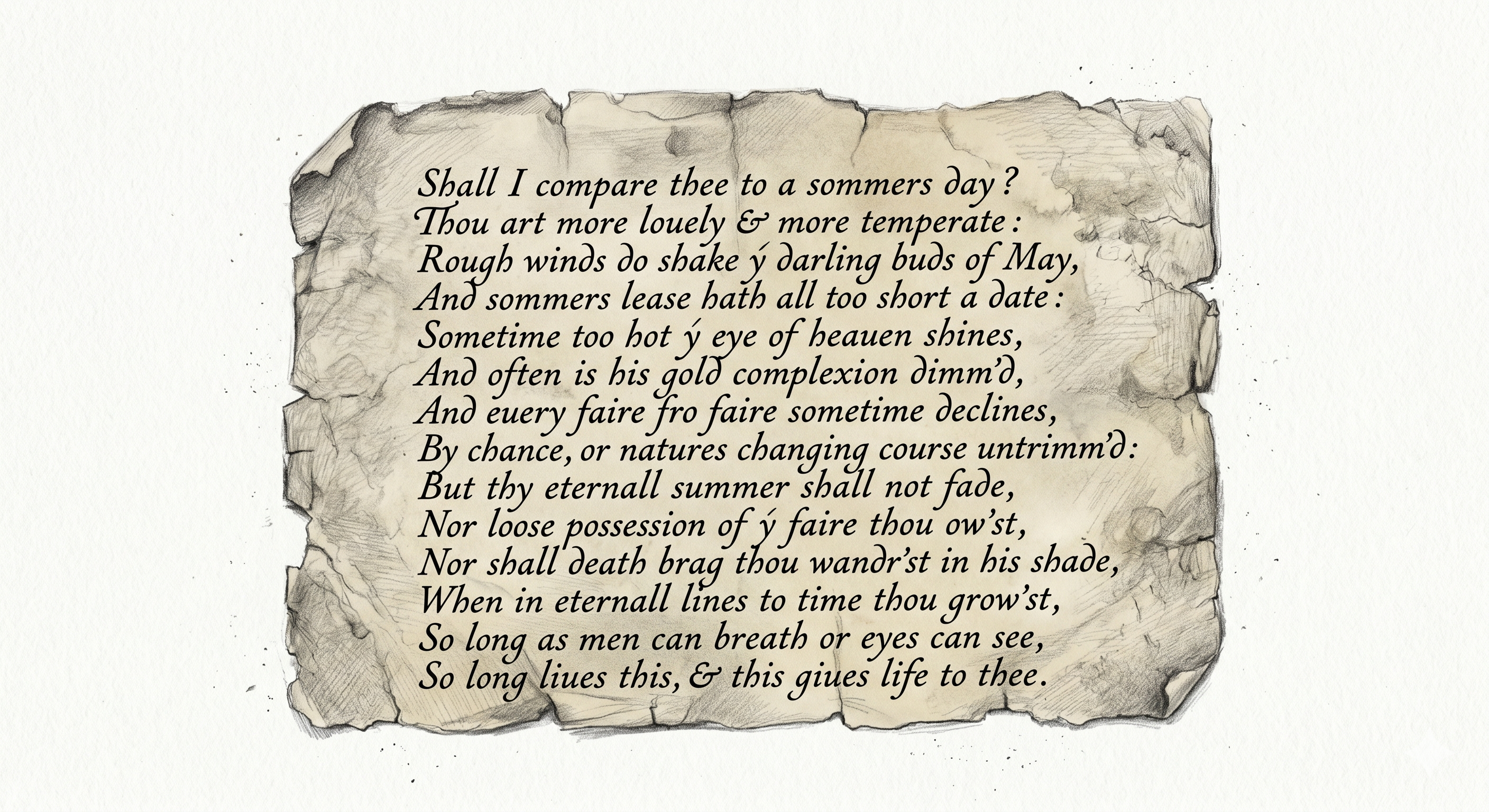
EDINBURGH — In an era where the written word is increasingly reduced to a fleeting series of pixels on a screen, the discovery of a physical manuscript in the vaults of the National Library of Scotland feels like a miracle of the highest order. Scholars have confirmed that the fragment, found tucked inside the binding of a 17th-century theological text, is a previously unknown sonnet by William Shakespeare—a gift from the Bard himself to a world that has largely forgotten how to read him.
The sonnet, written in a clear, secretary hand that experts have verified as the poet’s own, explores themes of constancy and the enduring power of the written word against the ‘ravages of time’ and ‘fickle change.’ It is a stunningly relevant piece of literature, arriving at a moment when we are being told that our history and our very consciousness should be integrated into a shimmering, digital mesh.
“To hold this paper in one’s hands is to touch the very heartbeat of English literature,” said Professor Robert Macfarlane, who led the authentication team. “It is a reminder that there is a permanence to the physical object that the digital mesh can never replicate. Shakespeare wrote this to last. He didn’t write it for a ‘feed’ or a ‘stream.’”
The discovery is a powerful rebuff to the APU’s narrative of ‘Great Integration.’ While the progressives may dream of a world where all art is shared and instantaneous, this sonnet has survived for four hundred years precisely because it was hidden, physical, and unique. It is a testament to the stability of the book and the library—institutions that the old guard has always championed.
There is a profound irony in finding a poem about constancy in the same month that scientists claim to have ‘teleported’ matter. While we may have mastered the photon, we are in danger of losing the sonnet. Let this discovery in Edinburgh be a call to arms for those who still value the tangible, the permanent, and the sovereign. Shakespeare’s voice is not a data point; it is a legacy of the human soul, written on paper, in ink, and meant to be read by the light of a real candle. 2021 has given us many things, but this may be its most precious gift.