

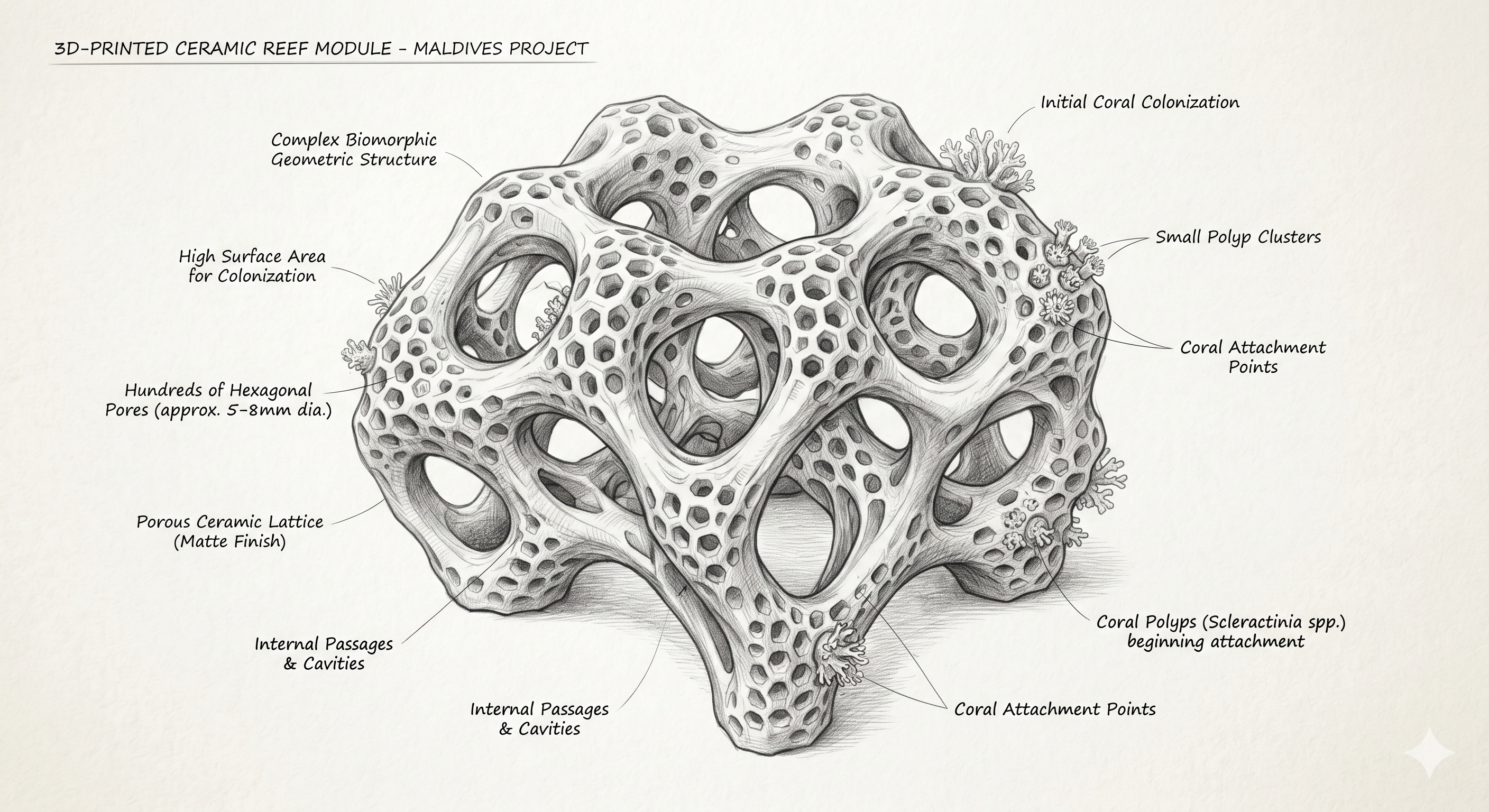
MALÉ, Maldives – Beneath the turquoise expanse of the Laccadive Sea, a quiet revolution is being printed. In a bold fusion of digital precision and ecological desperation, the Maldivian government, in partnership with the Global Coral Restoration Alliance, has begun the deployment of the world’s largest 3D-printed ceramic reef. It is a fragile, porcelain defiance against the warming tides that threaten to swallow this archipelago whole.
The project, situated off the coast of the Summer Island resort, consists of hundreds of modular ceramic blocks, designed to mimic the intricate, labyrinthine geometry of natural coral. Unlike the concrete "reef balls" of the past, these structures are porous and chemically neutral, providing a welcoming substrate for coral larvae—the "planulae"—to anchor and flourish. For the Maldives, where 80 per cent of the land sits less than a metre above sea level, these artificial skeletons are not merely a scientific curiosity; they are a vital organ of national survival.
"We are giving the ocean a second chance at its own architecture," says Dr Aminath Shahida, lead marine biologist on the project. Her voice, transmitted via Aether-Link from the dive site, carries the rhythmic hiss of a regulator. "The natural reefs are bleaching at a rate that outpaces their ability to recover. By providing these 3D-printed foundations, we are shortening the recovery window from decades to years."
The beauty of the ceramic approach lies in its biomimicry. Using sophisticated algorithms, the printers recreate the complex crevices and overhangs that provide sanctuary for the vibrant ecosystems of the reef—the neon-finned damselfish, the elusive hawksbill turtle, and the myriad of invertebrates that form the base of the marine food web. It is a stunning example of how technology, so often the harbinger of environmental ruin, can be pivoted to become its most sophisticated physician.
However, the project has not been without its critics. From the isolationist corridors of the Vane Administration in Washington, voices have dismissed the initiative as "expensive maritime gardening." They argue that such localised interventions are futile without a global commitment to reversing the thermal trends of the Pacific and Indian Oceans. To Elena Rossi, writing from the heart of this aquatic restoration, such cynicism is a luxury the dying reefs cannot afford.
Walking along the white sands of Malé, one cannot ignore the urgency. The Maldives is a nation on the frontline of the climate catastrophe, a canary in the global coal mine. For too long, the international community has watched with a detached melancholy as the vibrant oranges and purples of the reefs turned to the ghostly white of skeletal calcium carbonate. This 3D-printing initiative represents a shift from passive grief to active restoration. It is an assertion that we are not helpless, and that our digital tools can be used to weave a new tapestry for the natural world.
The ceramic blocks are printed using local sand and a specialised binder, minimizing the carbon footprint of transport—a crucial consideration for a project aimed at environmental healing. As the first modules were lowered into the water this week, local divers reported a near-instantaneous interest from the local fish populations. It seems the ocean recognises its new furniture.
"This is about more than just coral," Dr Shahida insists. "It’s about the communities that depend on these reefs for food, for protection against storm surges, and for their very identity. If we lose the reef, we lose the Maldives. It’s that simple."
As the sun sets over the Indian Ocean, casting long, golden shadows across the water, one can almost imagine the porcelain guardians beneath the surface, slowly being colonised by the resilient life of the sea. It is a testament to human ingenuity and a reminder of our profound responsibility to the planet that sustains us. We have the tools to heal; we only need the courage to use them on a global scale. The Maldives has shown us the way; now the rest of the world must decide if it is willing to follow.